Romeo Is Bleeding (1993): Fortune’s Fool
If David Lynch had directed 'Romeo Is Bleeding,' Roger Ebert would have creamed his pants.

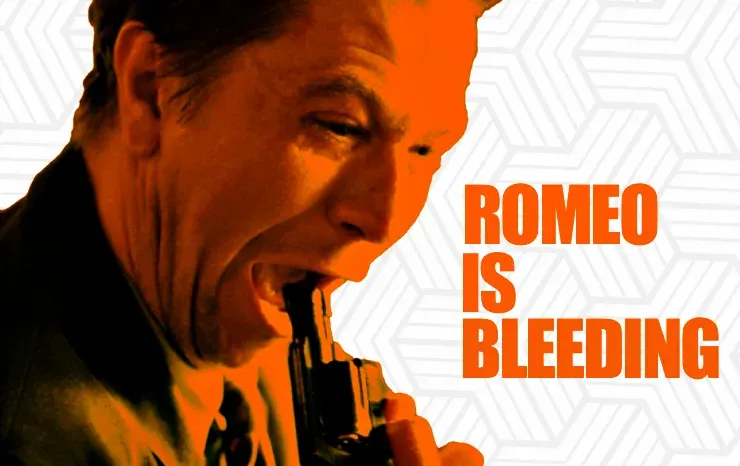
The early 1990’s was a rare period in film. Artistic and commercial interests briefly aligned, resulting in a five year stretch in which the Neo-Noir found itself at the centre of the cultural zeitgeist.
What began with Sea of Love in 1989 gained steam with films like Miller’s Crossing (1990), The Silence Of The Lambs (1991), Barton Fink (1991), Reservoir Dogs (1992) and Red Rock West (1993), reaching a crescendo with Michael Mann’s Heat (1995) and Quentin Tarantino’s Oscar for Best Original Screenplay at the 1995 Academy Awards.
Perhaps predictably, Pulp Fiction (1995) proved to be the high-water mark for this short but fruitful renaissance. Art and commerce diverged once more, and the earnest Neo-Noir devolved into something that resembled “erotic-thriller-mystery-sleaze-porn,” a style epitomized by films like Jade (1995), Showgirls (1995), Diabolique (1996) and Palmetto (1998). Produced with overwhelming commercial intent, these movies are the McDonalds of Neo-Noir: films that look and smell like the real thing, but don’t taste that way once they’re in your mouth.
So while Pulp Fiction represents the Neo-Noir’s 1990’s mainstream peak, my (unpopular) opinion is that Peter Medak’s Romeo Is Bleeding marked its artistic and creative climax.
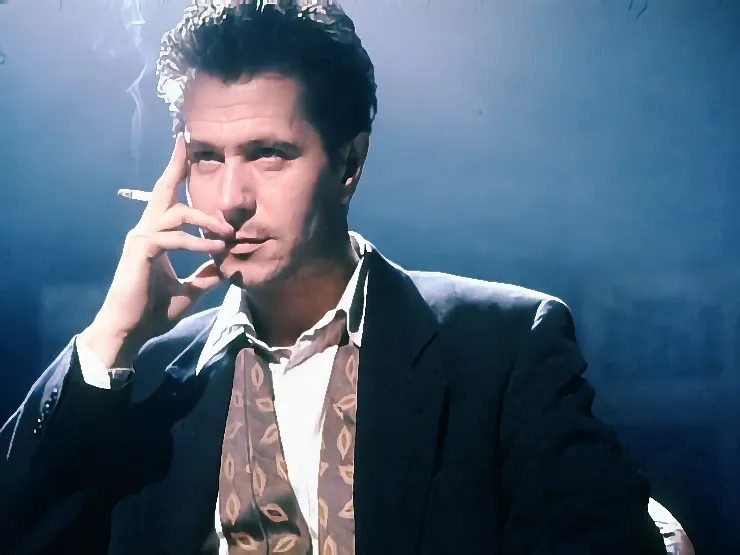
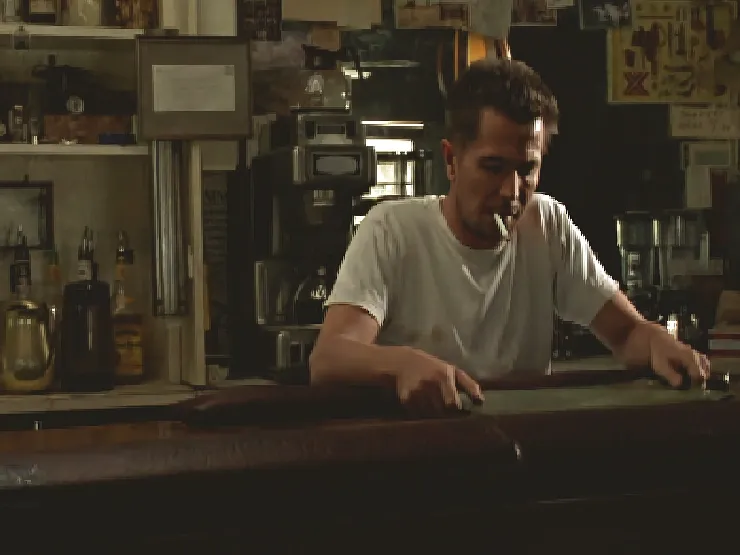
My favourite thing about Romeo Is Bleeding is its brilliant prologue, a black and white scene that possesses all the markings of a Rural Noir.
Languid jazzy trumpet underscores the bleak atmosphere of the empty country diner. “You ever seen a ghost?” the narrator asks, flipping through a photo album. The answer to this question is what keeps us watching.
It’s not long before we realize that the man in the photos is also the man behind the counter. He’s telling us HIS story, when HE was someone else. When he used to be a man called Jack Grimaldi. In other words, the “ghost” is him. This is Somewhere In The Night—without the amnesia.
The photo album is not only a framing device, it’s a jumping off point that draws us into the world of the film. It also establishes temporal structure: the photos in the album are from the past, which means despite the black and white filter, the prologue occurs in the movie’s present.
Most importantly, the album serves a crucial function in the plot. In this respect, we can think of it as “Chekov’s Photo Album.”
Technicalities aside, Romeo Is Bleeding’s opening sequence is a masterclass in style. The jazzy score, the first person monologue, the bleakly rendered rural atmosphere, a broken man who can’t out-run his past. These five essential Film Noir tropes, packed into a tight three minute prologue, signal exactly what kind of movie we are watching.
Finally, for the Classic Noir afficionados in the audience, the prologue is a call-back to Jacques Tourneur’s Out Of The Past (1947), a film in which the protagonist (Robert Mitchum) flees his unsavoury existence as a big city crook, changes his last name, and begins a new life running a gas station in rural California.
At the time of Romeo Is Bleeding’s initial release, critics called the plot “complicated” and deemed it “hard to follow.”
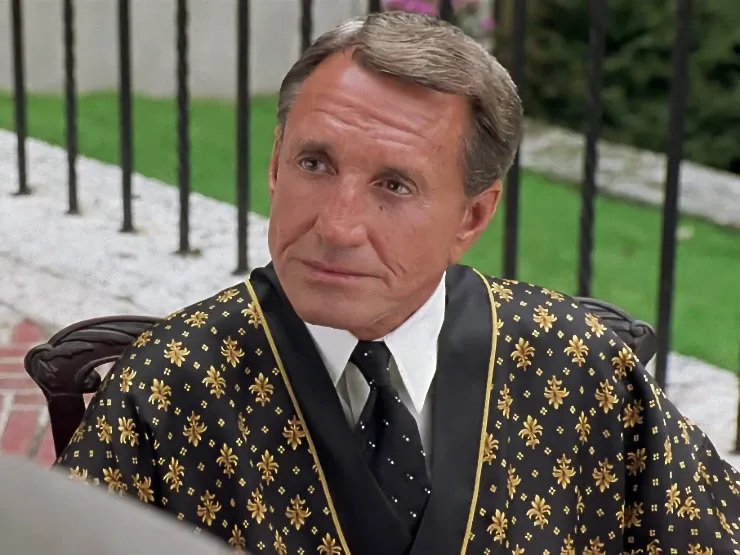
But a convoluted plot is a well established Film Noir trope. The Big Sleep came out in 1946 and we still don’t understand what the hell is going on! Having said that, I suspect audience discontent had more to do with pace than plot. For instance, it takes until the thirty-nine minute mark, through a law enforcement tape recording, for us to learn Mona Demarkov’s identity, country of origin, criminal history, and the reason she’s been arrested. Even then, we still have no idea how she fits into the plot, until Grimaldi’s meeting with Mafia boss Don Falcone (Roy Scheider) a few scenes later.
To be clear, I’m not saying the movie moves too slowly. I’m saying there’s a long delay between the narrative loops that open in the prologue and those that open forty minutes later. For some critics, it’s obvious this delay is just too long.
Thankfully, Grimaldi’s meeting with Falcone clarifies the plot and also sets the stakes. If Jack refuses to accept the job, his wife, girlfriend, career and family home are on the line. The fifty-thousand dollar payment is purely ornamental—it’s only offered to make sure Grimaldi doesn’t talk.
Quite literally ‘an offer he can’t refuse,’ Falcone’s demands are synonymous with a central tenant of the Film Noir genre: pulled into a criminal underworld through no fault of his own, the Film Noir anti-hero is forced to become a criminal himself.
Romeo Is Bleeding is essentially a single flashback, narrated in the movie’s present by the man in the diner. Although this flashback is mostly linear, there are instances of “flashing forward” to the film’s third act, including one expressed as a particularly vivid nightmare.
While these temporal flourishes are central to post-modernism, they also tell the audience what they’re watching is indeed a Neo-Noir.
Film Noir stories are generally linear. While simple narrative flashbacks are commonplace, jumping backward and forward and backward again is an innovation that belongs to the Neo-Noir period, which began in the middle of the 1960’s.
Without getting too far into the weeds, Film Noir narratives were influenced by Modernism, which in turn was influenced by Einstein’s General Relativity. In short, the idea that one’s experience of reality is relative to one’s position in space and time.
This idea differs from Post-Modern narrative structures, which are influenced by Quantum Mechanics. These narratives are constructed in a way that mirrors the behaviour of sub-atomic particles, which have no fixed point in space or time, skip randomly in and out of existence, change their behaviour the moment they are observed, become permanently entangled with other particles after a collision, travel across the universe in an instant, and under certain conditions can exist in two places at once.
Quantum Mechanics has also influenced the arts by introducing concepts like the multiverse, inter-dimensional travel, and oscillating viewpoints pertaining to the probabilistic vs. deterministic nature of the universe.
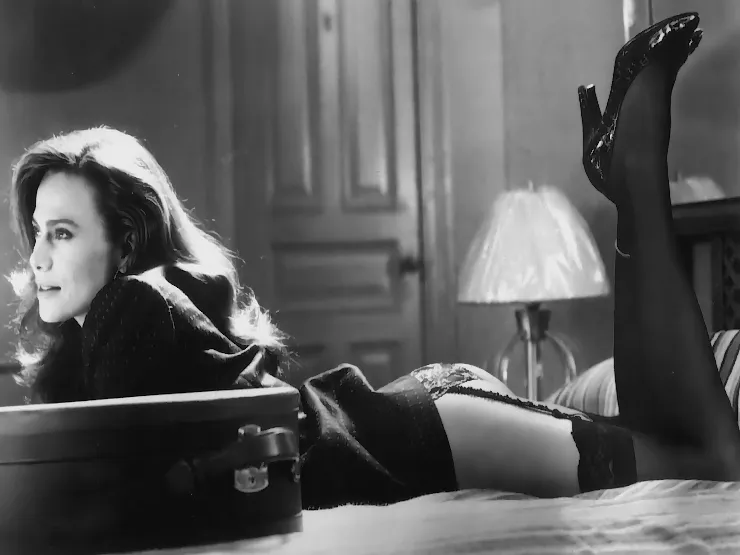
Romeo Is Bleeding is peppered with Film Noir references, some of which are more overt than others. Like in any literature, the grand purpose of these allusions is to “import” qualities of other texts or stories, which in turn adds depth to the overall narrative without adding length or narrative complexity.
Unfortunately the process doesn’t work for viewers who lack a certain pedigree. If the audience is unfamiliar with the films being referenced, these allusions fail to augment the film they’re watching. At any rate, consider the following:
- Grimaldi takes Demarkov’s phone call at the local bar, something he has clearly done before. In a world where pagers, cell phones, and offices exist, this is clearly a throwback to Hardboiled detectives like Philip Marlowe, Sam Spade and Mike Hammer.
- Grimaldi “protects” Demarkov in a seedy hotel room. Although part of his official duties, this is obviously not standard police practice. The hotel room sets the scene for a manipulative sexual encounter synonymous with the Classic Film Noir Femme Fatale.
- “An Offer You Can’t Refuse:” After Mafia Boss Don Falcone makes Jack an offer he literally can’t refuse, Mona Demarkov makes him a counter-offer he figuratively can’t refuse: $365,000 to help her fake her own death, change her identity, and skip town.
- Grimaldi playing both sides of the law, and both sides of the underworld (Demarkov vs. The Mafia), is another well-established Film Noir trope, evoking films like Night and The City (1950) or Double Indemnity (1946).
- Scenes involving the Coney Island amusement park are references to films like Nightmare Alley (1947), The Lady From Shanghai (1947) and The Third Man (1949).
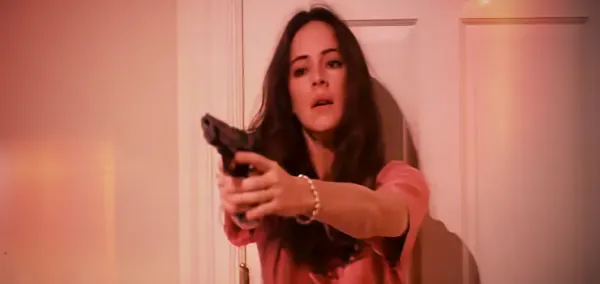
- In a dream sequence, when Grimaldi’s wife, Natalie (Annabella Sciorra) pulls a gun on him in their kitchen, the film suggests there are in fact THREE competing Femme Fatales at play within the story. This exaggeration tells us we are watching satire—with the volume cranked up to eleven. Crucially, by enveloping this instance within a dream, the film avoids any notion of parody or farce.
- “That Old Voice:” In addition to the first-person voice over that emanates from the prologue, an additional voice-over introduces itself when Grimaldi’s life begins to unravel. In the context of the film, this second voice illustrates the dual nature of the standard Film Noir Anti-Hero: not quite good and not quite bad, but somewhere in between.
- More importantly, this “double voice-over” is yet another example of Romeo Is Bleeding’s clever tendency to hyper-exaggerate established Film Noir tropes. While a single voice-over is a tired cliché, two competing voice-overs constitute both thoughtful satire and a bold step forward for the genre.
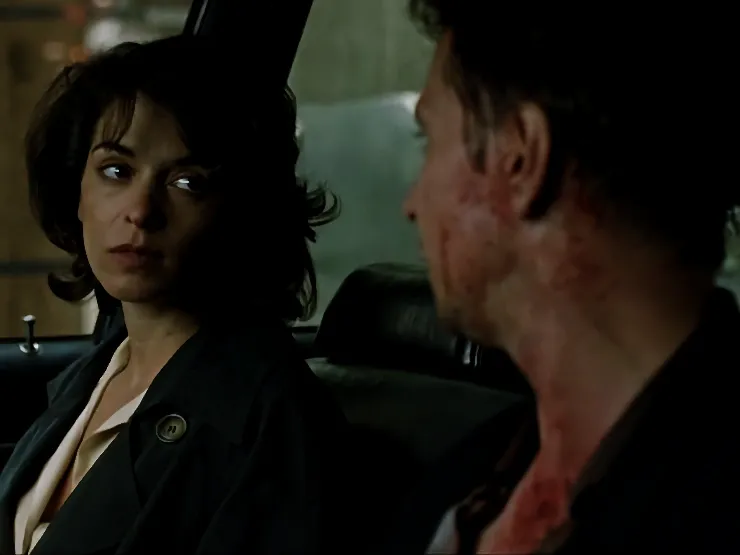
As this is not an academic paper, I won’t attempt to pen a fulsome definition of “Maximalism.”
Having said that, I’m confident this layman’s definition will suffice: Maximalism is a Post-Modern narrative mode that exaggerates established genre tropes until they reach absurd or grotesque proportions, either obliterating our existing notion of a given genre, or creating new ones altogether.
While ostensibly a film that deals with love, betrayal, ambition and regret, Romeo Is Bleeding is ultimately a movie about movies. The world of the film contains components of every other Neo-Noir—except juiced up on steroids and tweaking on a nostril full of pure cocaine. In this respect, it calls back to Robert Altman’s 1973 adaptation of Raymond Chandler’s classic novel, The Long Goodbye. Both films carefully subvert and satirize their respective idioms in order to remain fresh and relevant. Both films make the genre new again.
Romeo Is Bleeding thusly signals the artistic peak of the Early Nineties Neo-Noir period, honoring the past, while also offering a preview of the Neon Noirs that would follow in the decades to come.
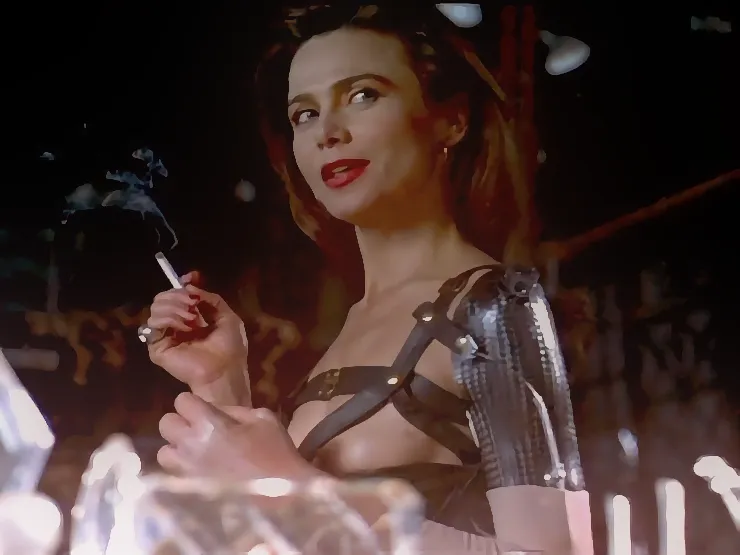
Despite the prevailing online consensus, Romeo Is Bleeding is an absolute blast. It’s a complicated post-modern Neo-Noir masterpiece that deserves your time, attention and respect. I’m confident that much like Thief (1981) and The Long Goodbye (1973), eventually, Romeo Is Bleeding will also get its due.
Until then—fuck the critics.
If David Lynch had directed Romeo Is Bleeding, Roger Ebert would have creamed his pants.
That’s all for now.
See you in the movies,
Tod
© Copyright 2026 by Debtford Press. All Rights Reserved.