Red Rock West (1993): A Stranger Comes To Town
In 'Red Rock West,' we are no longer confined to the cluttered offices, grimy motel rooms and crowded casino floors of 'Kill Me Again.'

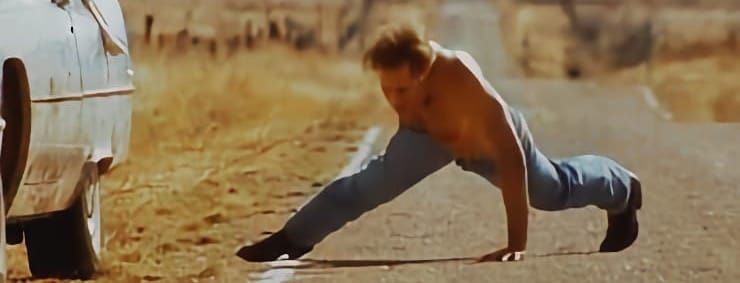
The first thing you notice about Red Rock West is its sun-baked colour palette. Grainy browns, hazy whites, washed out reds and blues. Like a faded cotton t-shirt, or a postcard turning yellow on a windowsill, these are the visual hallmarks of an atmospheric Neo-noir. This depth and texture gives the film far more cinematic cogency than Dahl’s 1989 debut. With many scenes taking place outdoors, it’s also more expansive. In Red Rock West, we are no longer confined to the cluttered offices, grimy motel rooms and crowded casino floors of Kill Me Again.
I’m also a big fan of the prologue. Red Rock West’s opening scene dispenses with the gimmicky temporal shifts or cheesy hooks so prevalent in the action thriller movies of the eighties and nineties. No time dependent crisis that only a hero can solve. No evil genius forcing the protagonist to choose between saving the world and saving his family. In other words, the hook is that there is no hook. The prologue simply tells us what we're watching—and also what we’re not.
No need for world building here. This story takes place firmly in OUR world, and the film wants us to know it. Objects, landscape and clothing convey time, place and context. No one tells us what kind of man Michael is. We learn about him by the way he uses his environment as he cleans up for the job interview. We know he’s ex-military before he even opens his mouth to tell us.
Finally, the prologue also invokes the first of many Western tropes that underscore the broader narrative. Michael is the stranger that comes to town. His white Cadillac tells us he’s the good guy, or at the very least, the best guy in a movie full of scoundrels.
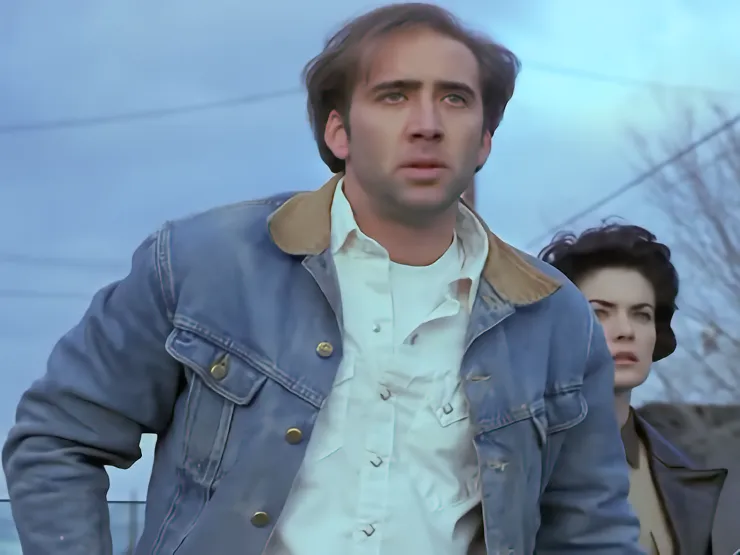
Red Rock West’s initial story setup should be familiar to fans of Jim Thompson’s rural Neo-noirs:
- A malleable drifter rolls into town and gets caught between a woman and a pile of cash.
- A corrupt small town Sheriff runs amok until his power finally wanes.
But Dahl diverges quickly from these tropes, employing plot twists and misdirection more akin to Joel and Ethan Coen’s early masterpiece, Blood Simple (1983). Chief among these devices is that of mistaken identity: first when Michael is confused for Lyle, and later, in the third act, when we discover that Suzanne and Wayne are also opportunistic imposters.
When executed properly, such devices add narrative drive to a text that would otherwise be lifeless. Having said that, too many twists, with too little relevance, can frustrate the audience into a state of ambivalence. For a practical example of this mistake in action, check out Amsterdam (2022). So how do writers perpetuate narrative drive without relying too heavily on rhetorical gimmicks?
One option is to use found objects to keep the viewer engaged. Most (good) mysteries use a “Chekhov’s gun” style approach: seemingly irrelevant objects appear briefly at the outset, taking on increased significance as the plot unfolds. What would M. Night Shyamalan’s The Sixth Sense (1999) have been without the wedding ring? Probably a lot like Old (2021).
Another source of narrative drive can be progressive repetition. Read any novel by Stephen King and tell me I’m wrong. But progressive repetition gets tedious if said repetition is employed simply to achieve a technical effect like ramping up suspense. Both the style and degree of repetition must mirror the nature of the story and its protagonist in order to remain compelling.
Cage’s Michael is the quintessential “honest thief.” He lives by a Robin Hood style code from which he never deviates. He thinks nothing of stealing money from another crook, and yet, he still can’t bring himself to lie on a job application or ignore a person in distress.
Michael’s honesty is what drives the plot during the gaps between its major twists: the job application, telling Suzanne the truth about her husband, collecting the injured pedestrian, admitting to Lyle that he’s an ex-Marine, going back to Suzanne’s house to rescue her from Lyle—all of these decisions serve to drive, complicate, and amplify the basic plot.
Crucially, Michael’s repeated inability to make the wrong decision seems completely consistent with the characterization presented in the film’s opening scenes, thereby creating a film with both narrative drive AND contextual plausibility.
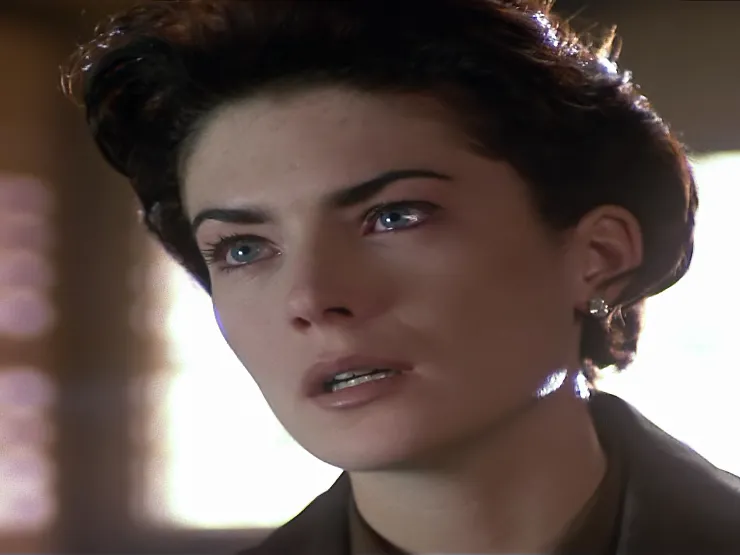
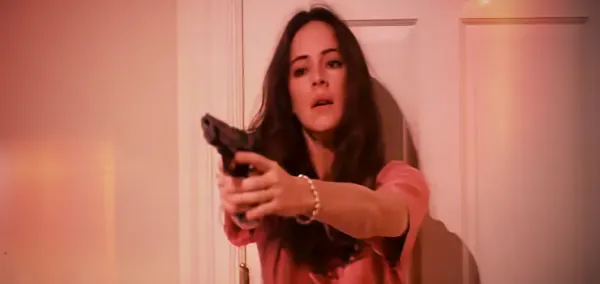
In Lara Flynn Boyle’s portrayal of Suzanne, we soon identify a through-line reaching back to Dahl’s first femme fatale, Kill Me Again’s Fay Forrester (Joanne Whalley). Like Fay, Suzanne is both a victim and a perpetrator: the victim of an abusive husband, while also a thief and an adulterer in her own right. In fact, Suzanne inspires the question: “What if Fay Forrester had survived Kill Me Again? What kind of life would she be leading next? What kind of man would she seek out?”
Suzanne’s crimes stem far beyond the scope of Fay’s relatively minor infractions. She is wanted on a Federal Warrant. Her options are death, escape or a long custodial sentence. The stakes in Red Rock West are simply much higher. Unlike Fay Forrester, Suzanne has nothing left to lose.
And yet, despite such fertile ground, Flynn Boyle’s performance is entirely underwhelming. When the second twist is revealed, and we realize Wayne and Suzanne are criminal imposters, we simply aren’t convinced she could have pulled it off. Had she starred alongside anyone but Cage and Hopper, her acting liabilities would have been more painfully exposed. But luckily for Boyle, we’re so mesmerized by those two maniacs, we often forget she’s even there.
The truth is Boyle’s Suzanne lacks the essential contradiction possessed by every classic Femme Fatale: Push and Pull. The Femme Fatale must attract and repel. Seduce and reject. She’s The Madonna AND The Whore. You’d lie and cheat and steal for her. You’d probably die for her too.
But Lara Flynn Boyle’s Suzanne is not a woman you would die for. She’s not even worthy of a memorable death. Michael simply throws her off the train and continues living his life.
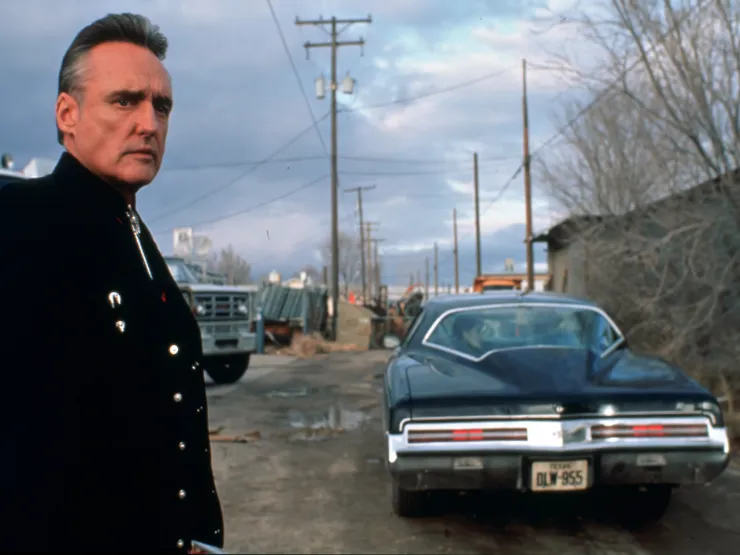
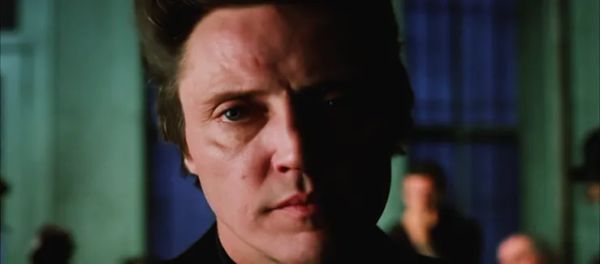
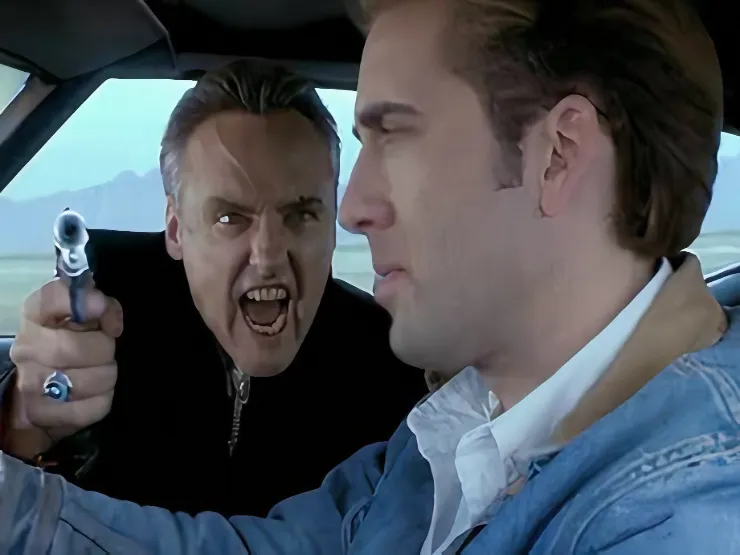
Legendary actor/director Dennis Hopper plays “Lyle from Dallas,” a slightly different take on “Vince,” the heartless killer portrayed so well by Michael Madsen in Dahl’s debut, Kill Me Again. Like Madsen, Hopper gives us a character who has no limits. We don’t trust him, the other characters don’t trust him, and he doesn’t even trust himself.
But while Vince is a true psychopath, a man who kills for next to nothing, “Lyle From Dallas” is more complicated. Lyle is as businessman, a professional. Always in black, with a big black car, he puts on a kind of Johnny Cash persona. He puts effort into his personal style and presentation—his brand—so to speak. He’s friendly and polite, particularly to strangers. Having served in the military, he considers himself a citizen and a patriot. These traits help Lyle camouflage a deep-seated sense of insecurity, and perhaps, a degree of femininity as well.
Lyle is desperate to be liked, even by his victims. The slightest hint of disrespect ignites a furious release of violence. Consider this passage, just after Lyle kidnaps Wayne, Suzanne and Michael at gunpoint:
“Scotch ain’t good enough? Oh I knew a guy like you once. Thought he was better than everybody else. Hot shit, ain’t you Mike? You think you’re better than me? You think you’re hot shit, don’t ya Mike? Hey cowboy—who’s got the gun? You keep your foot on the gas.”
Hopper’s “Lyle From Dallas” is not a true psychopath. But he’s absolutely a sociopath, and more than likely a narcissist as well. We wonder about his time in the military, presumably in Vietnam, and how those missions shaped his worldview and psychology. We wonder why and how he was discharged from service.
Part of what makes Red Rock West a superior film to Kill Me Again is its use of mirroring. All the characters mirror each other in one way or another, which adds both depth and ambiguity to the narrative. A more complex protagonist therefore requires a more complex villain.
Lyle From Dallas is more than just a Western-style villain, dressed in black with a big black hat (or car). As a former marine, a transient, and a hired gun, Lyle is a possible version of Michael’s future life.
By defeating Lyle, Michael rejects a future of violence, delusion and materialism, thereby defeating those same tendencies within himself.
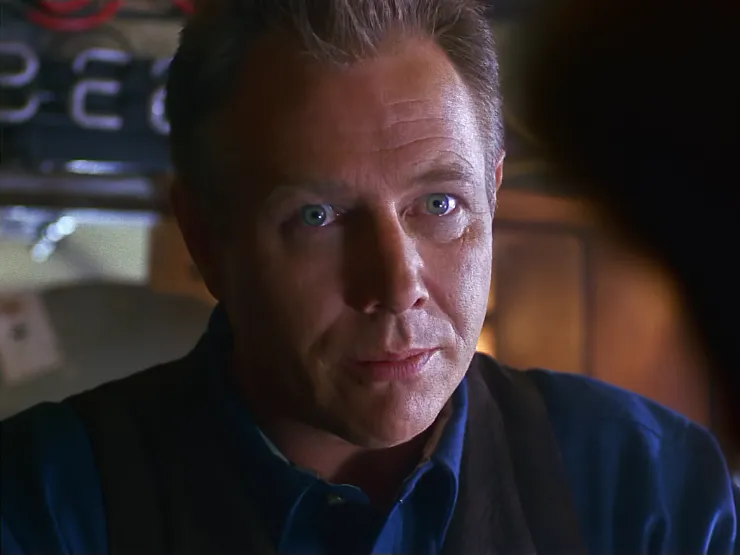
In Red Rock West, wisely, Nicolas Cage plays it straight. One can imagine him engaging in a tit-for-tat maximalist acting battle with Dennis Hopper, like he did with John Travolta in Face/Off (1997), and with his younger self in The Unbearable Weight Of Massive Talent (2022). But with just a few well-timed outbursts, and presumably very little improvisation, Cage gives the cast, the setting and the story enough room to breathe. He stays in his lane with an understated, brooding performance that conveys the essential conflict contained within the psyche of the film’s protagonist.
Michael is a man whose good intentions collide with his survival instinct. A man who does the right thing at the wrong time and get punished for it, every time. He’s not the power hungry megalomaniac of Scarface (1932). He’s not the desperate loser of Night and The City (1950). He’s not the naive bumpkin of The Green Cockatoo (1937). Nor is he the grieving addict of Dahl’s first film, Kill Me Again (1989).
Cage’s Michael is a man of rules and principles, a disciplined outsider that lives by his own strict code. Echoing Frank in Michael Mann’s Thief and Jackie Cogan in Andrew Dominik’s Killing Them Softly, his time on screen possesses existential circularity. He wanders into the story the same way he wanders out of it. Michael comes to town without a past, and exits the film without a future. Without money, friends or prospects, what he gains is purely introspective. Finally he knows, without a doubt, that he can only rely on himself.
That's all for now.
Thanks for reading.
See you in the movies,
Tod.
© Copyright 2026 by Debtford Press. All Rights Reserved.