China Moon (1994): Eventually They All Fuck Up
While audiences will forgive a film for bending its own rules, China Moon’s plot is so disordered that such forgiveness soon becomes impossible.

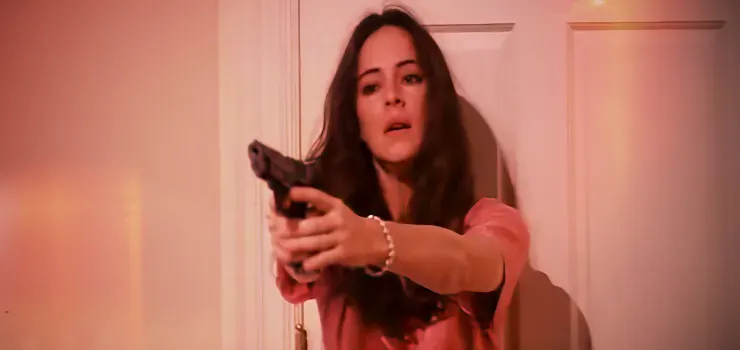
While not a perfect movie, one thing about China Moon is clear: this film would not get made today—it barely got made to begin with.
China Moon’s first act respects the audience far more than a contemporary detective mystery. Its plot relies on simple misdirection. If you don’t watch and listen carefully, you miss the clues. And if you miss the clues, well that’s too bad.
Today’s movies lack the courage to alienate viewers who barely pay attention. Clues are shoved into our faces again and again, often through expository dialogue, all to ensure people scrolling through their phones don’t miss out when the cheesy final twist pays off.
Having said all that, China Moon is really not that great. But this mediocrity raises another important point.
Low-budget niche films don’t get theatrical releases anymore—they go straight to streaming—often with acting and production values similar to that of porno movies.
While I understand the underlying economics, fewer theatrical releases means talented young actors have fewer opportunities to prove themselves. And this means we see the same people over and over again, via casting decisions based purely on popularity. Ever wonder how Nicole Kidman ends up in every show and movie in existence? It’s not just by leveraging her plethora of wigs. It’s about the battle for attention, the quest for rankings within algorithmic recommendation engines that reduce artistic merit down to vector mathematics and statistical inference.
In other words, green-lighting new projects these days is mostly about name recognition and marketing synergies. Pro athlete cameos, culture war rage bait, genre-mashing Book-Tok romance novel bullshit. Anything to make you click.
So, yeah, in the world of 1990’s Neo-noir, China Moon is a mediocre film at best. But at least it’s a film. I’d take it over some shitty Marvel superhero circle-jerk any day of the week. I’m not interested in two-hour commercials for the associated toys, video games, theme parks, cruise ships and Halloween costumes that populate Disney’s flaccid plain vanilla catalogue. I want to watch a fucking MOVIE.
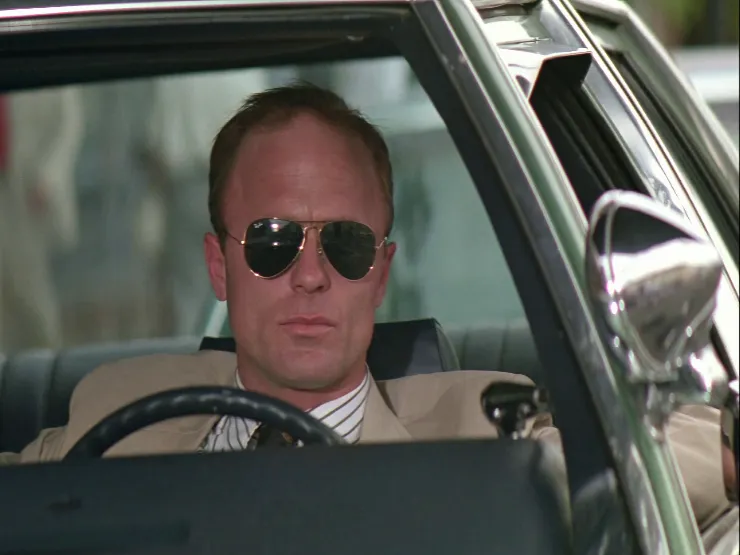
China Moon‘s first act sets up a red-herring that rivals anything that happens in the actual story. For about twenty-five minutes, we actually think we’re watching something good.
Ed Harris delivers Kyle’s macho detective bullshit with enough hubris to make him the perfect mark. He’s got no respect for criminals, even the smart ones. This arrogance creates fertile ground for poor decision making—the basis for most Film Noir plots. Consider this exchange:
Kyle: “You’ve got no eye for detail.”
Lamar: “Why’d you pick me if I’m such a bad partner?”
Kyle: “I keep thinking you might surprise me.”
Lamar: “Maybe I will.”
Lamar (Benicio Del Toro) evades our detection the same way he evades Kyle’s. Quiet, dutiful and passive, Lamar is practically an extra. And that’s where this film excels.
If you want to go along for the ride, the first half is a lot of fun. If you watch it carefully and immerse yourself in the details—the details ARE ACTUALLY THERE. Watch it twice and you’ll see what I mean.
Lamar’s complaints about his modest salary, Kyle and Rachel’s “accidental” meeting at the bar, Rachel’s motel handgun purchase, the payphone call that starts act two: all these scenes are short and vague enough to open up compelling narrative loops, little nagging questions that push and pull the story forward.
But despite its promising start, China Moon’s plot goes off the rails midway through the second act. Here, it becomes important to remember the distinction between story and plot:
Story is what happens.
Plot is how it happens.
And while China Moon contains the ‘turn, twist and double-cross’ format that constitutes the standard Film Noir plot, these elements are presented in the wrong order. More importantly, there are problems with the film’s narrative point of view.
The first act is a success because we are in lockstep with Kyle as he navigates his day. So while we may notice little details that Kyle doesn’t, we encounter the film’s other characters and situations at the same time as he does. But this changes as the film goes on, with several scenes shot from someone else’s POV.
The problem with this shifting narrative lens is that it deflates the film’s dramatic tension. If we have access to a “God’s Eye” view of Rachel buying a gun or making a phone call, why aren’t we privy to her relationship with Lamar, or their plans to kill her husband?
While audiences often forgive a film for bending its own rules, China Moon’s plot is so unordered that such forgiveness soon becomes impossible.
Long before the movie ends, we know by process of elimination that Lamar (Del Toro) is trying to frame Kyle (Harris) for the murder. We don’t know this by anything the film tells us, we know it by simple mathematics.
There are only five characters in this movie with speaking lines, and one of them is dead. Lamar is thus the only possible suspect, regardless of any suspense the film attempts to create.
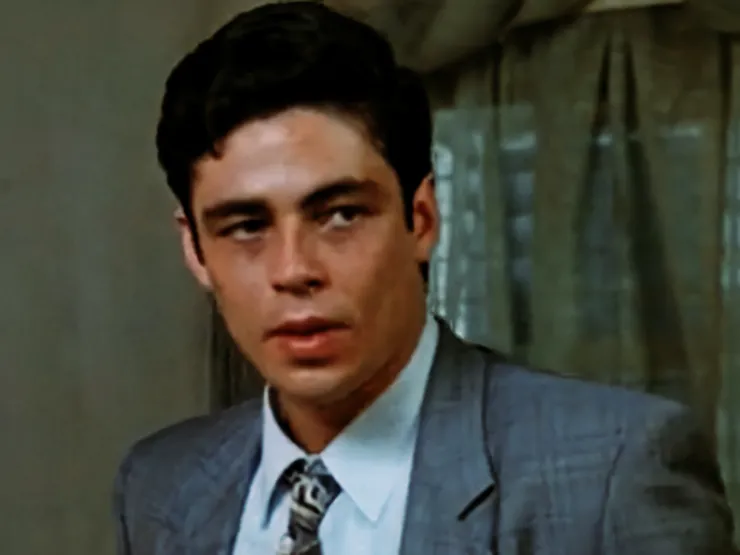
Another one of China Moon’s problem is the timing of its big reveal. Kyle expends a lot of energy trying to deduce two things: who is framing him, and whether Rachel is involved or not. But instead of showing us his investigation, slowly cranking up the tension, and then resolving the plot at the climax, China Moon reveals the truth through expository dialogue—with over twenty-five minutes to go!
Devoid of narrative drive, those last few scenes become a slog. We hope for another, better twist, something that will blow our minds before it's too late. Sadly, our hopes are quickly dashed. Kyle confronts Lamar in a night club parking lot. They argue back and forth until the cops show up and shoot Kyle in the chest.
Next, with Kyle dying in her arms, Rachel grabs the gun and shoots Lamar at point blank range, in full view of an entire police platoon.
And then the movie’s over.
What?!
My favourite use of symbolism in China Moon is a subtle scene at the police station, midway through the film’s first act.
Lamar (Del Toro) and Kyle (Harris) are discussing their initial call to Rachel’s home. As they patter back and forth, Lamar unfolds a silk handkerchief and sprays it with cologne, before he carefully returns it to his blazer pocket. This one brief scene tells us everything we need to know about Lamar: he has expensive taste, and there is more to him than meets the eye.
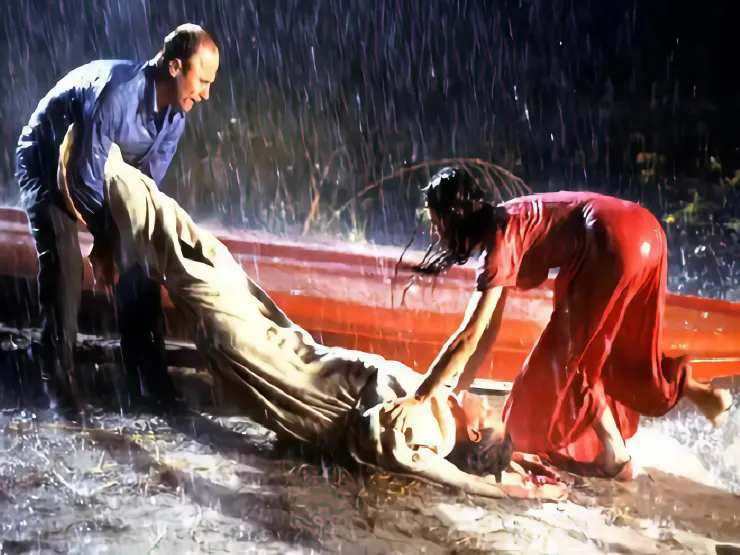
Of course, the rowboat scene provides the film’s most obvious and fertile source of symbolism. Traversing the river represents the crossing of a delta. Moving past a moral line, from which there is never any turning back. This scene tells us we are leaving the police procedural and entering the world of Noir.
Rachel’s presence in the rowboat scene invokes several other archetypal symbols. As she provocatively undresses in the moonlight, she moves from victim to temptress, a standard Film Noir trope.
As she swims and frolics in the water, Rachel echoes the Sirens of Greek and Roman mythology, thereby deepening the temptress metaphor.
Finally, as Kyle succumbs to Rachel’s charms and joins her in the river, on a symbolic level, he is plunging downward, away from his high moral standards, toward doom, death and ultimately—hell.
The most iconic Femme Fatales are the ones who never have to ask. The male victim volunteers himself willingly, he almost begs to be destroyed. The prime example of this trope is Billy Wilder’s brilliant Double Indemnity (1944). All Phyllis (Barbara Stanwyck) has to do is answer her front door.
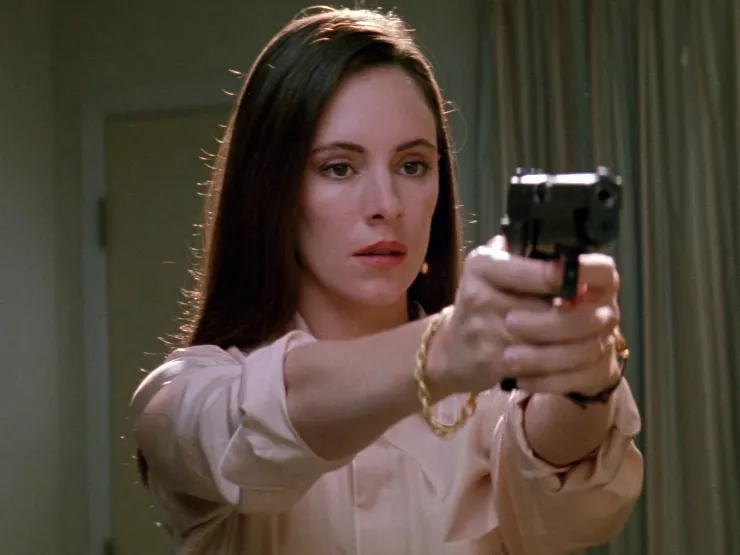
But unlike these classic Film Noir counterparts, Madeleine Stowe’s Rachel Munro conveys a bit more depth. I don’t mean the trite contemporary quasi-intellectual social media driven bullshit “strong female lead” sense of the word, I’m talking about the ACTUAL meaning of “complex:”
Rachel kills for money, but she’s already rich.
She kills because she’s bored and angry and jealous.
She kills because she wants to.
She kills because she thinks she can get away with it.
Rachel kills like any man in any film. In fact, China Moon would be a better movie if Rachel was the protagonist. The same exact story, told from HER perspective, would have found its way to theatres much, much faster.
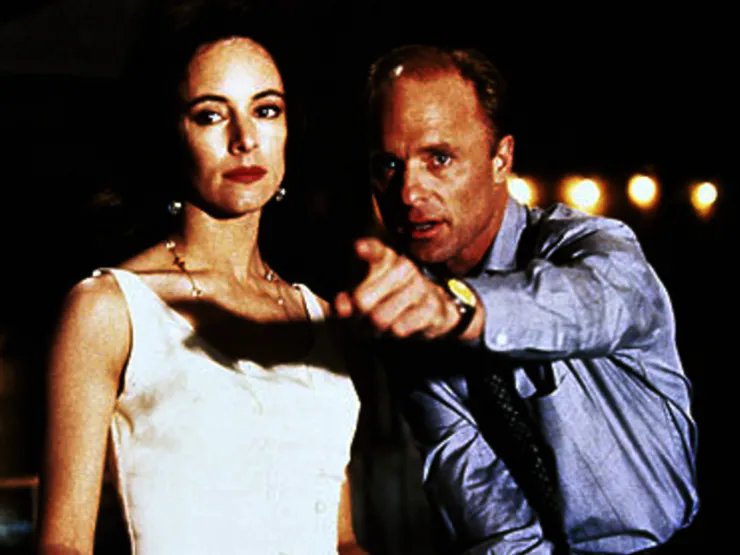
The real tragedy when it comes to China Moon is its failure to maximize the talents of its cast. Even though there’s only half a dozen characters in the entire movie, they’re all incredible actors. Given its release was delayed by three full years, one wonders if the film’s best parts were left on the cutting room floor.
But despite its many flaws, I still have a soft spot for China Moon. The film conveys distinctive Florida vibes that go beyond just road signs and flip flops and cruise wear.
Its “Florida-ness” is palpable, evoking a humid seedy atmosphere I find similar to films like Wild Things (1998), Scarface (1932), Netflix’s Bloodlines (2015) and Michael Mann’s Miami Vice (2006).
Houseboats. Palm trees. Cocaine. Old money. New money. Bikinis. Even more cocaine. This intersection of drugs, money, lust, humidity and violence is also present in Elmore Leonard’s Rum Punch (1992) and The Big Bounce (1969), or any of John D. MacDonald’s famous Travis McGee novels.
“Florida Noir” is a legitimate sub-genre, and for whatever reason, China Moon seems to tap into that aesthetic, at least for me. Unfortunately, the movie can’t decide what it wants to be, or even from which perspective the story’s being told.
Re-configured as a straight up Neo-noir, perhaps with a first person voice-over, Ed Harris could have really shown his chops. Conversely, with a third person point of view, increased access to Del Toro and Stowe would have raised the stakes, heightening the drama as their scheme unraveled.
What China Moon really needs is MORE. Another twist. Another double cross. Another suspect. A frantic getaway that ultimately fails. A showdown in the swamp at sunset. Alligators, jaguars, snakes, a small flat boat powered by an enormous ceiling fan. A death trap. A better title.
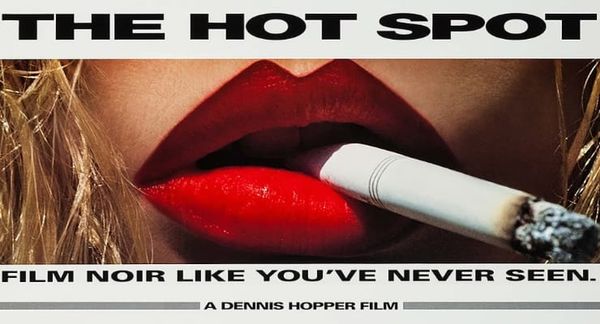
Elements like these would have vaulted China Moon into the ranks of better early nineties Neo-noirs, films like King of New York (1990), The Hot Spot (1990) or John Dahl’s amazing Red Rock West (1993).
So check out China Moon when you’ve run out of other things to watch. Until then—leave it on the shelf.
That’s all for now.
See you in the movies,
Tod
© Copyright 2026 by Debtford Press. All Rights Reserved.