Kill Me Again (1989): John Dahl’s Subtle Rural Noir Debut
Beyond its literal story, John Dahl’s Kill Me Again is ultimately a film about debt. What do we owe ourselves? Each other? Those who pass away?

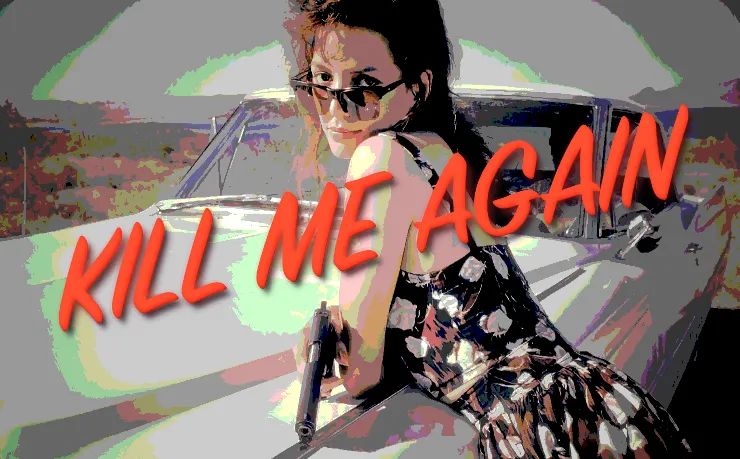
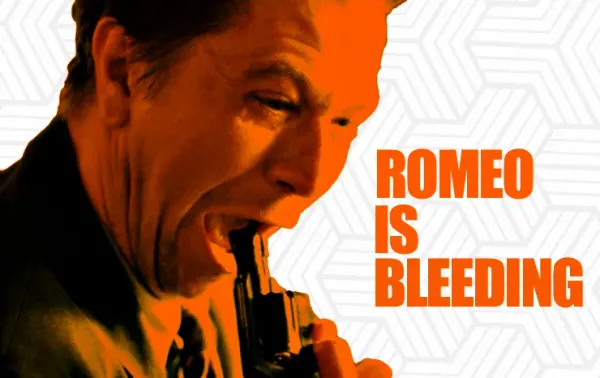
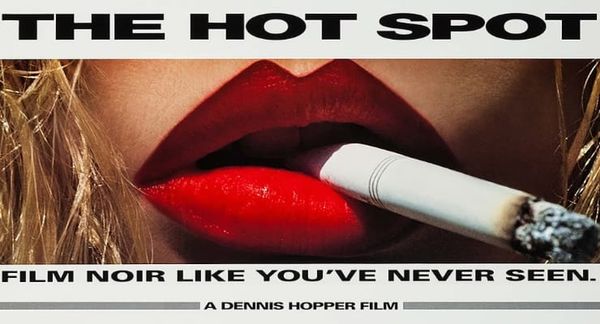
Largely ignored upon its initial release, Kill Me Again kicked off a string of earnest Neo-noirs like The Hot Spot (1990), Bad Lieutenant (1992), After Dark, My Sweet (1990), Romeo Is Bleeding (1994), Pulp Fiction (1994) and China Moon (1994).
Unlike the original Neo-noirs of the 1970’s, which took their cues from the Classic Film Noir era, these films were set in the Deep South or the American Mid-West, inspired by the Rural Noir fiction of writers like Jim Thompson, Charles Willeford and Charles Williams.
Despite a lack of critical praise, this small cluster of films almost certainly primed audiences for the maximalist Erotic Thriller period that began a few years later. While retroactively cringe-worthy and hilarious, films like Basic Instinct (1992), Consenting Adults (1992), Sliver (1993), Body of Evidence (1993), Showgirls (1995), and Jade (1995) ultimately have their roots in this brief but compelling Neo-Noir revival.
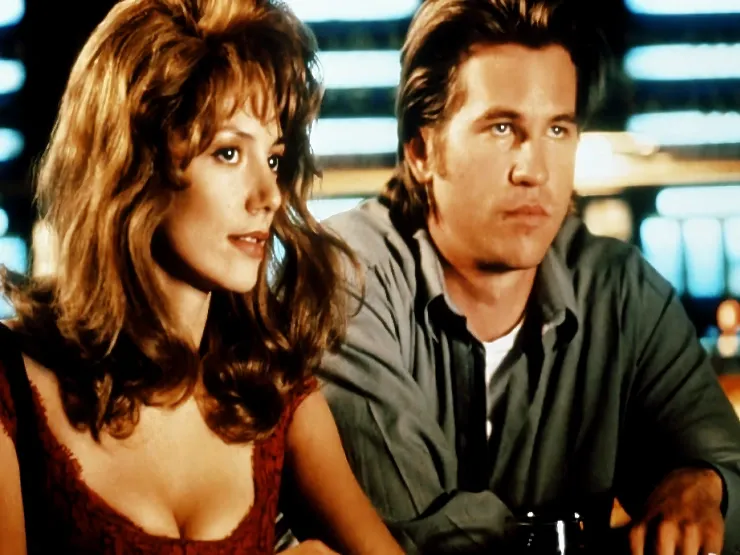
The first person limited point of view has always been strongly associated with Film Noir and Hardboiled fiction. The “Noir voice,” if there is such a thing, would not exist in its present form without private detectives like Philip Marlowe narrating their experiences. While much of this cultural clout stems from the popularity of various radio shows in the pre-television era, Noir’s enduring relevance runs much deeper than that.
The Noir detective usually finds himself excluded from society at large. Not quite a cop, not quite a crook. Not quite good and not quite bad. Never rich but paying all his bills. Existing in this interstitial space evokes a lonely, isolated, cynical and often paranoid persona. How else does a writer present this particular psychology if not via the internal monologue?
The original Neo-noirs, films like Alphaville (1965), Point Blank (1967), The Long Goodbye (1973), Chinatown (1974) and Taxi Driver (1976) are all examples of well- executed first person limited point of view.
We only see what the protagonist sees. We only hear what they hear. The protagonist is present in every scene, although sometimes absent from prologues or epilogues. Writers often circumvent these rules by incorporating flashbacks, dream sequences and media clips, but for the most part, the best films adhere to this internal logic with rigour and consistency. Curiously though, Kill Me Again departs from these conventions in favour of the third person limited point of view.
We see the world through the eyes of multiple characters, but we’re never privy to their inner thoughts. We never glimpse their fates before they do. While the primary protagonist may posses the dominant perspective, his/her presence is not required for the film to unfold. In this respect, Kill Me Again is more akin to a proto-Noir like The Green Cockatoo (1937), in which the narrative perspective shifts as the “A”and “B” stories play themselves out, eventually converging into a single point of view when the respective protagonists form a cohesive duo in the third and final act.
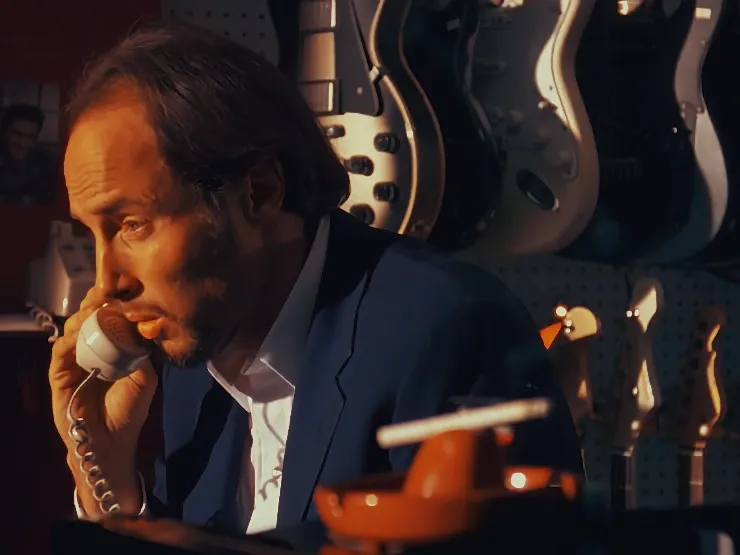
In just a few brief shots, the first scene in Jack Andrew’s office tells us everything we need to know about him as a man. The seedy decor, downtown Reno glowing in the windows, bottles of booze, the smashed photo of his dead wife. Like the shattered picture frame, Andrews is a broken man: lonely, foolish, vulnerable, and looking for a way out.
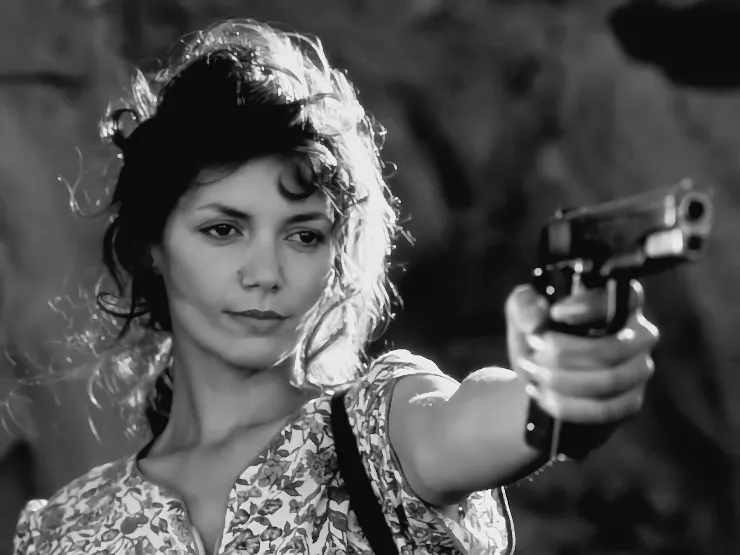
The same can be said of the robbery sequence that opens the film. When Fay (Joanne Whalley) hits Vince (Michael Madsen) in the head and makes her escape, she passes up an opportunity to kill him, despite knowing he would offer her no mercy if the situation was reversed. Before she hits the road, she even kisses him on the mouth. Her actions do not signify a true goodbye. Through Fay, the audience knows that Vince will return at some point later in the film, and that his grip on her soul will be just as strong.
But the film’s best use of visual storytelling is the scene in which Jack pays a visit to his dead wife’s grave. After a brief moment of mournful reflection, the camera pans across the tombstone, coming to a stop on the side of the plot reserved for Jack. His year of birth is etched in stone, while the year of his death is left blank. This scene tells the audience the film will end with Jack’s death, either literally, figuratively, or both.
While a seasoned cinephile may shrug at such basic use of foreshadowing and visual narrative, one must nonetheless stop and compare these elements to the amateurish tripe we are subjected to in modern day films. Namely, I’m referring to the odious and incessant use of expository dialogue.
Typically this emanates in unprompted soliloquies used to explain a character’s (often irrelevant) backstory, or as a verbal deus ex machina that glues a poorly plotted film together. Sometimes, it even seems as though this scripted diarrhea exists merely to achieve the ninety-three minute runtime the Netflix algorithm so obviously favors.
A simple test of quality is thus as follows: If you chose to watch the movie with the sound turned off, would it still be enjoyable? Better yet—would it still make sense? Kill Me Again passes this test by a mile. The Perfection (Netflix) (2018) on the other hand, sadly, does not.
Beyond reminding us how far the average script has fallen since the 1980’s, Kill Me Again’s visually expressed notions of inevitability calls back to the best movies of the classic Film Noir era, infusing films like Night And The City (1950) and The Third Man (1949) with an ever-creeping sense of fatalistic doom.
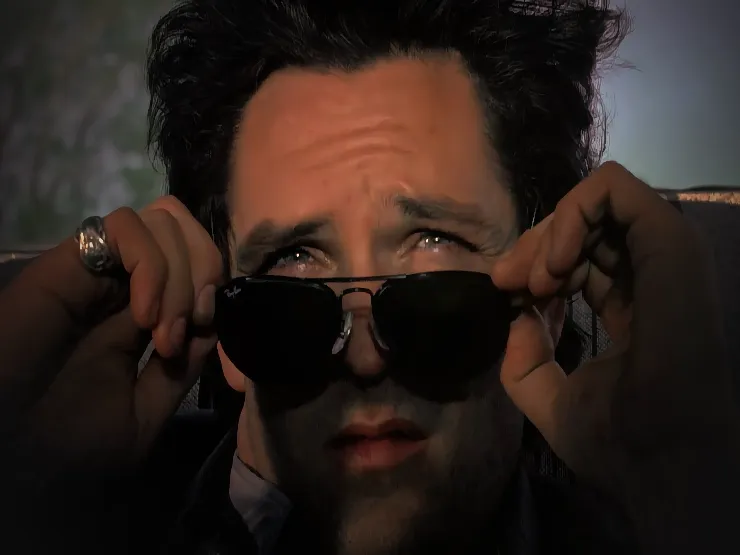
After a series of tranquil landscape panoramas during the opening credits, Kill Me Again moves briskly from scene to scene, using only brief shots to establish time and place. This film does not insult its audience, nor does it intentionally obfuscate the pertinent details. Some elements are rightfully withheld in order to augment the narrative drive, and the viewer is simply trusted to follow along.
A good example of what I mean is the way Dahl shoots the stolen money. Instead of a briefcase full of unmarked bills, Fay’s stacks of cash are wrapped in distinctive green rubber bands. No one points this out verbally. The camera doesn’t linger on the money either. But later, when it turns out the cash is traceable, we aren’t left feeling duped. Good films makes choices. Bad films make edits. Kill Me Again is full of well made choices like this one.
Oddly under-represented in both film and literary criticism, The Fool’s Journey is an alternative archetypal structure to that of Greek and Roman Mythology, Religious Texts, or the recently ubiquitous Hero’s Journey / Mono-myth.
Drawn from The Tarot, The Fool is the protagonist in the many stories that can be constructed by merely shuffling the deck. The Fool forms the locus of the plot, the character with whom the tale begins and ends. Without his aimless wanderings, the story cannot unfold. The Fool is also the zero card, importing yet another layer of meaning into texts that incorporate this archetype.
Unlike the standard hero, a common peasant who leaves his modest home; passes a series of tests; briefly loses his way and undergoes a psychological awakening; emerges from a hellish underworld unscathed; defeats the final monstrous threat thereby saving all humanity; finally returning home to discover he is actually of noble birth—The Fool’s Journey is not a perfect circle.
The Fool wanders through city and country; encounters friend and foe, glory and tragedy, birth and death, good and evil, wise men, witches, warlocks, kings and queens and charlatans. His quest is not to save his kingdom, a beautiful princess, or humanity itself. Instead, the mystery he unlocks is purely existential.
At the end of all his wanderings, The Fool discovers the truth of his own existence. This truth has been hiding in plain sight all along, within him and without him, but reveals itself in a moment of sublime epiphany, in which he realizes that the four elements of nature, and the holy trinity, are both centered by the soul of man.
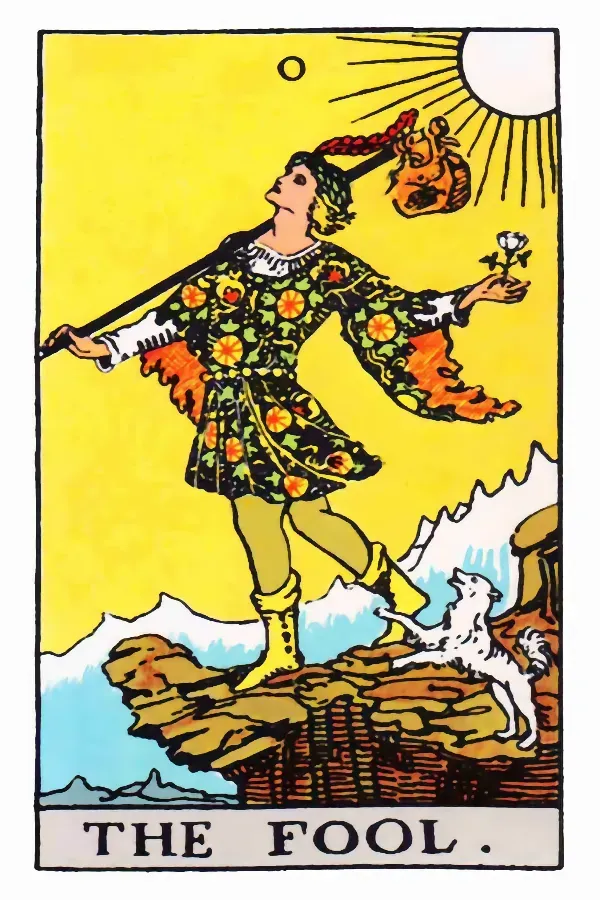
The Fool Archetype appears with stunning frequency in both Existential Noir Literature and Hardboiled Detective Fiction. Consider The Fool Card, pictured below:
In Existential Noir Fiction, we see the wandering fool personified by Albert Camus’s Meursault (The Stranger, 1942), Samuel Beckett’s Molloy and Malone (Molloy, Malone Dies, 1951), and Nathaniel West’s Homer Simpson (The Day of The Locust, 1939).
I would also argue strongly that Hermann Hesse’s Steppenwolf (1927), Frank Kafka’s Josef K. (The Trial, 1925) and several protagonists in the work of Thomas Pynchon follow The Fool’s Journey as well.
In Hardboiled Detective Fiction, the detective is almost always The Fool. Note that in this hypothesis, I’m not talking about police procedurals, I’m talking about true Hardboiled Fiction, where the private detective or amateur sleuth operates outside the system of policing, often working to uncover a mystery that itself has no legal ramifications.
On The Fool Card, pictured above, The Fool is striding happily off the edge of a cliff. He carries some kind of loot on his back, and is followed by a small white dog. This scene forms the archetypal basis for most Detective Fiction. The protagonist wanders blindly into a dangerous situation, with little chance of survival. There is always a financial motivation that inspires the journey, and the detective nearly always has a sidekick, a literal representation of the little dog.
We see the sidekick emerge early in the mystery genre via Dr. Watson, Sherlock Holmes’s loyal, obedient partner. Incidentally, Holmes dies after falling off a cliff while fighting with his nemesis, the evil genius Dr. Moriarty.
In the 1930’s and 40’s, the sidekick is typically booze. Of all the Hardboiled Detectives, Philip Marlowe exemplifies The Fool to the most obvious degree, quite literally wandering into danger, often without the slightest notion of what is really going on. In fact, the mystery that occupies the majority of each Marlowe narrative is never the mystery he sets out to investigate in the first place. Chandler’s famously incoherent plots are perhaps the greatest evidence of the Fool Archetype at work.
More recent examples of literary sidekicks include TJ from Lawrence Block’s A Walk Among The Tombstones (1992) or Jackson Blue in Walter Mosley’s Devil In A Blue Dress (1990).
In contemporary cinema, we see the Fool’s Journey everywhere. Despite what seems like thousands of critics striving to unpack The Big Lebowski (1998), rather curiously, most of them have missed the point. The Big Lebowksi follows the Fool’s Journey almost to a tee. Skeptics should read P.D. Ouspensky’s The Symbolism Of The Tarot (1913) or A.E. Waite’s The Pictorial Key To The Tarot (1911) and tell me I’m wrong.
John Wick is absolutely The Fool in the first two instalments of the action franchise. Various characters from The Tarot also make appearances, none more prevalent than Wick’s pet dogs.
Director Nicolas Winding Refn puts The Tarot front and center in Only God Forgives (2013), The Neon Demon (2016) and Too Old To Die Young (2019). Nearly all The Tarot’s characters make figurative appearances, while Refn’s respective protagonists are most certainly based upon The Fool. Refn makes this symbolic order more literal in Too Old to Die Young, in which every episode bears the title of a different Tarot card.
More recently, Syfy network’s Happy! checks every archetypal box, including an imaginary sidekick who is basically a cartoon dog.
In Kill Me Again, the cliff from The Fool Card is both literal AND figurative. The cliff represents Jack Andrews figuratively losing control of his compulsions, while literally losing control of his vehicle. Andrews is The Fool, walking blindly off these literal and figurative cliffs not once, but twice. His sidekick/figurative pet dog is his loyal buddy Alan Swayzie (Jon Gries), following him blindly, covering for him repeatedly, and taking brutal beatings to protect his safety.
Crucially, Kill Me Again ends without a legal resolution or the sense of a concrete ending. Andrews solves his existential crisis, escapes the labyrinth of his poor decisions, and journeys east to Arizona. We don’t find out what happens to him next. All we know is that his foolish wanderings are certain to continue.
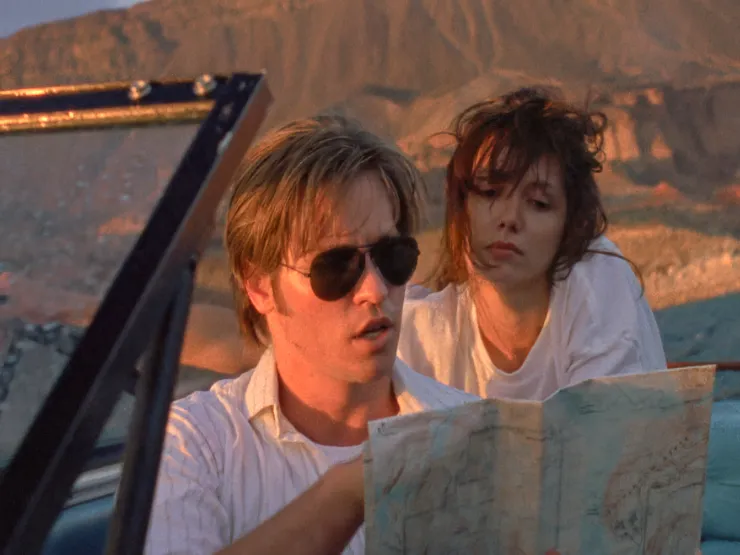
Kill Me Again’s most compelling twist is purely figurative. In the seedy, Neo-noir world of the film, the ‘right’ choice for Jack is to do something wrong. His second plunge into the lake is not just part of a clever double-cross, it’s a figurative death. He sacrifices Fay, absolves himself of guilt and debt, and rises from the water re-born. Baptized.
Jack is only free to move on with his life when he realizes that his best choice is to keep driving, to prioritize his own interests and move forward, regardless of the obstacles that lie ahead. In this respect, Jack has much in common with Frank, the protagonist from Michael Mann’s 1981 debut, Thief.
Contradicting the standard Hollywood symbol for starting over fresh, Jack Andrews does not “Go West” to progressive California. Instead, Dahl ensures we know that Jack is driving East, speeding toward conservative Arizona.
As the closing credits roll, it’s not a stretch to think of Kill Me Again as another Neo-noir that rejects collectivism and state intervention in favour of individual freedoms, self-reliance and libertarian capitalist ideology.
Beyond the literal story, Kill Me Again is ultimately a film about debt. What do we owe ourselves? Each other? Those who pass away before us? How far will we go to honor those debts?
With settings in Reno and Las Vegas, there are obvious allusions to the moral weight of gambling itself, suggesting certain debts are steep enough to end the lives of those who risk it all and lose.
The final act also invokes themes of indigenous reconciliation, implying that gambling towns like Reno and Las Vegas are built on lands that hold historically shameful kinds of debt.
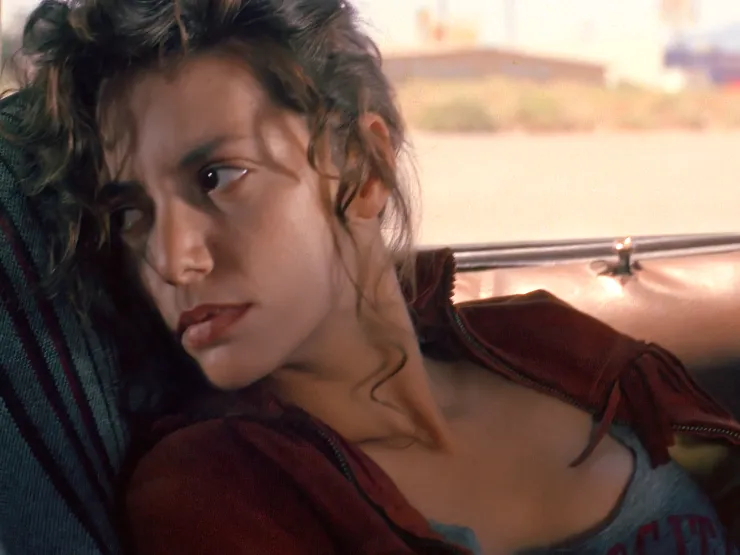
Adrift in an ever-expanding ocean of video content, Kill Me Again is an underrated gem that would sadly not get made in today’s milquetoast media environment.
Genre fans will immediately pick up on its connections with spiritual Rural Noir cousins like Terrence Malick’s Badlands (1973) and Joel and Ethan Coen’s Blood Simple (1984).
Along with a handful of contemporaries, it forms a retroactively significant cluster of Neo-noirs that deserve your time, attention and appreciation.
So if you’ve never watched Kill Me Again, be sure to check it out. And if you already have—it might be time to check it out again.
That’s all for now.
See you in the movies,
Tod.
© Copyright Debtford Press 2026. All rights reserved.